Some of the limitations below may have been removed.
The limitations listed below were true in mid-July, 2026.
Enhancements to CaPTURE were in progress.
DEPOSITED MODELS:CaPTURE 2026.
accepts a PDB ID code and reports the energetically significant*
cation-pi interactions in the deposited model (asymmetric unit).
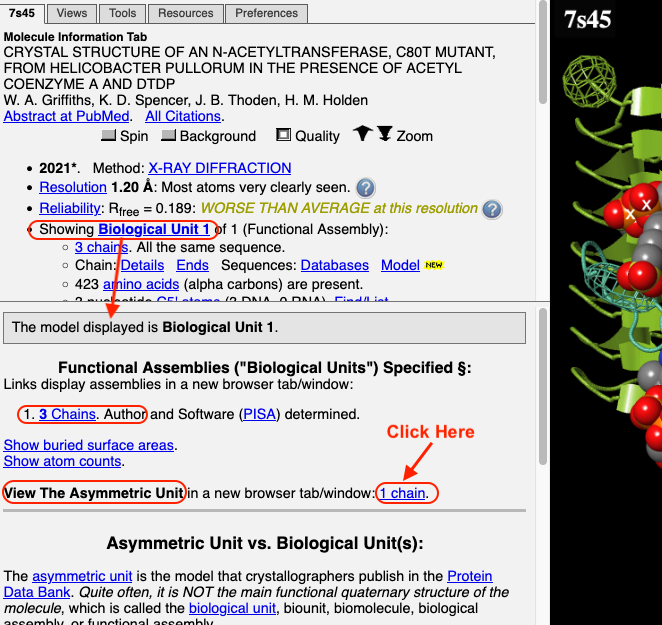
Initially, FirstGlance shows you Biological Assembly 1.
In FirstGlance, click on Biological Unit 1, then on the link to
View the Asymmetric Unit for comparison (see snapshot at right).
To get the significant cation-pi interactions in a biological assembly:
Enter the 12-character PDB ID (for example pdb_00007s45)
and biological assembly number here to download the assembly
.cif file.
LIMITATIONS:
CaPTURE 2026 (mid-July, 2026) and FirstGlance in Jmol
have the following limitations:
CaPTURE omits cation-pi interactions involving cationic amino-termini of protein chains.
The Ends Tool of FirstGlance reports all protein termini, and whether the are charged.
The Salt Bridges/Cation-Pi Tool of FirstGlance attempts to show cation-pi interactions
involving amino-termini. Example:
3m4d.
CaPTURE ignores
D-amino acids.
FirstGlance reports putatative cation-pi pairs involving D-amino acids.
There are more than 700 entries in the wwPDB that include D-amino acids.
Example:
5hhc.
Neither CaPTURE nor FirstGlance report cation-pi interactions involving non-standard
amino acids or ligands.
CaPTURE may Report incorrect energies when the residues in a cation-pi interaction have
alternate locations. FirstGlance
does not report energies. About 43% of entries in the wwPDB have alternate locations.
* ENERGETIC SIGNIFICANCE is defined as follows by CaPTURE
(Gallivan & Dougherty, 1999), where E(es) is electrostatic
energy, and E(vdw) is van der Waals energy: