|
PDB ID,
Method,
Resolution Å
|
Function
|
Carbohydrates
(N-linked unless otherwise stated)
|
Carbohydrate Chain IDs2
|
Non-Standard Residue Chain IDs
|
Water Chain IDs2
|
|
1jyn,
X-ray, 1.8
|
β-galactosidase
|
Disaccharide ligands 1 (lactose)
|
Unique
|
|
Protein
|
|
1igt,
X-ray, 2.8
|
Immunoglobulin G
|
Nonasaccharides gycosylation
|
Unique
|
|
|
|
7bbv,
X-ray, 1.2
|
Pectate lyase B
|
Monosaccharide ligands.
O-linked to Thr, Ser.
|
Mono: protein.
|
|
|
|
3t5o,
X-ray, 2.9
|
Human complement C6
|
C-mannosylated tryptophans.
N- and O-linked mono- and di-saccharides.
|
Mono: protein.
Di: unique.
|
|
|
|
6rhe,
X-ray, 3.1
|
O-GlcNAcase
|
N-acetylglucosamine S-linked to Cys.
|
Mono: protein.
|
|
|
|
7wv3, EM 2.3
|
Toll-like receptor
|
Mono- and di-saccharide glycosylation
|
Mono: protein. Di: unique.
|
|
|
|
9bvo, EM 4.4
|
Carboxylase
|
Mono- and di-saccharide glycosylation
|
Mono: protein. Di: unique.
|
|
|
|
8xy9, X-ray 3.6
|
Angiotensen-converting enzyme + COVID spike
|
N-linked mono-, di-, and tri-saccharide glycosylation
|
Mono: protein. Di/tri: unique.3
|
|
|
|
2kqo, NMR
|
Unsulfated chondroitin 10.
No SEQRES.
|
Carbohydrate ONLY
|
X in COMPND 5 record.
|
|
|
|
1c58, X-ray 1.0
|
Cycloamylose 10.
No SEQRES.
|
Carbohydrate ONLY
|
A, B in COMPND 5 records.
|
|
Carbohydrate
|
|
148L, X-ray 1.9
|
Lysozyme with covalent enzyme-substrate intermediate
|
Covalently linked muramic acid(MUB)-NAG.
|
MUB-NAG: unique (A)
|
Unique (S)
|
Protein (E) and non-standard residues (S)13
|
|
1a0t, X-ray 2.4
|
Porin with sucrose
|
Disaccharide ligands 1
|
Unique
|
|
Protein 4
|
|
1a78, X-ray 2.0
|
Toad ovary galectin
|
Thio-digalactose ligands 1
|
Unique
|
|
Protein 6
|
|
3gzt, EM 3.8
|
Rotavirus capsid
(BU1 = 60X AU)8
|
N-linked NAG dimers.
|
Unique
|
|
|
|
8y3j, EM, 3.2
|
Dengue virus capsid
|
N-linked NAG monomers and dimers.
|
Dimers: unique. Monomers: protein.
|
|
|
|
8yvy, EM 3.0
|
Semliki forest virus capsid and spike proteins (not full capsid)
|
12 N-linked trisaccharides.
|
Unique, upper and lower case letters.
|
|
|
|
5t01, X-ray 1.9
|
C-Jun DNA-binding domain + DNA.
|
None
|
|
|
Protein, DNA
|
|
PDB ID,
Method,
Resolution Å
|
Function
|
Carbohydrates
(N-linked unless otherwise stated)
|
Carbohydrate Chain IDs2
|
Non-Standard Residue Chain IDs
|
Water Chain IDs2
|
|
3agv, X-ray 2.2
|
Immunoglobulin + DNA/RNA aptamer
|
Oligosaccharides
|
Unique
|
|
Protein, DNA, RNA
|
|
3kle, X-ray 3.2
|
HIV reverse transcriptase + DNA
|
Disaccharide (absent in 3/4 biological units)
|
Unique
|
|
Protein, DNA
|
|
6bhj, X-ray 2.8
|
HIV reverse transcriptase + DNA/RNA aptamer
|
Disaccharides
|
Unique
|
|
Protein, RNA 7
|
|
6yrb, X-ray 2.3
|
Glycoprotein + RNA (BU1 = 6X AU). 8
Chain B in BU1 is B4-B7 (no "B").
|
Tetrasaccharides
|
Unique
|
|
Protein, RNA
|
|
1f8b, X-ray 1.8
|
Flu neuraminidase (BU1 = 4X AU) 8
|
Mono-, di- and heptasaccharides
|
Mono: protein. Di and hepta: unique.
|
|
Protein 9
|
|
6evv, X-ray 2.5
|
Thrombin + DNA aptamer
|
Octasaccharide
|
Unique
|
|
Protein, DNA
|
|
176d, NMR
|
Polypeptide-nucleic acid (PNA) + RNA
|
|
|
Unique 11
|
|
|
1m06, X-ray 3.5
|
Bacteriophage capsid (BU1 = 60X AU) 8
|
|
|
Unique (dideoxyribofuranose phosphate)
|
|
|
7LKC, X-ray 1.0
|
Keratinimycin A (glycopeptide)
|
Mono- and disaccharides
|
Mono: protein. Di: unique.
|
Unique (heptapeptides with only 1 standard amino acid)
|
Protein 9
|
|
7dc4, X-ray 1.0
|
Glycan-bound lectin
|
Pentasaccharides
|
Unique
|
|
Protein 9
|
|
8g82, X-ray 1.2
|
Vancomycin (glycopeptide) bound to D-Ala-D-Ser. (BU1 = AU/5) 8
|
D-glucose vancosamine dimers
|
Unique (some lower case)
|
Unique (heptapeptides with only 1 standard amino acid)
|
Protein 9
|
|
1ao2, NMR
|
Metalloglycopeptide pepleomycin
10
|
None
|
|
Unique (A)
|
|
|
2kvj, NMR
|
Polypeptide-nucleic acid (PNA)
10
|
None
|
|
Unique (A, B) 11
|
|
|
3c1p, X-ray 1.0
|
Polypeptide-nucleic acid (PNA)
10
|
None
|
|
Unique (A,B,C,D) 12
|
|
|
2LSC, NMR
|
Arabinonucleic acid and 2-fluoro arabinonucleic acid (ANA, 2F-ANA)
10
|
None
|
|
Unique (A,B) 12
|
|
|
1bp8, NMR
|
Mithramycin + DNA
|
Di- and trisaccharides
|
Unique
|
|
|
NOTES:
Examples shaded green above
are a subset covering most cases.
- "Ligands" means non-covalently bound.
- "Protein" means that the carbohydrate or water has the same chain ID as
its associated protein chain.
For water: (i) "carbohydrate" means that some (or all) water molecules have the same chain
name as their associated carbohydrate chain;
(ii) "DNA" or "RNA" means that some water
molecules have the same chain ID as their associated nucleic acid chain;
(iii) A blank cell means the model has no water.
-
When 8xy9 was first released January 22, 2025, the di- and tri-saccharides had
chain IDs of the protein. This entry was remediated on February 12, 2025,
to be consistent with policy:
the di- and tri-saccharides were assigned unique IDs E-L while leaving
the monosaccharides with protein chain IDs A and C.
-
All water bound to carbohydrate is also bound to protein.
No water is given the chain ID of the carbohydrate to which it is bound.
- Carbohydrate chains are NOT listed in COMPND records
unless there are neither protein nor nucleic acid chains.
- HOH146 is bound to GAL2:F and not to the closest protein chain B (4.5 Å),
but is given chain ID B. Deposited in 1998 without the electron density map.
- HOH101 is assigned to chain E (DNA), but the closest DNA atom is 3.25 Å,
too far for a hydrogen bond. Protein is farther away. The electron density map
is consistent with HOH101 being the correct distance from the DNA.
-->
- BU: Biological Unit. AU: Asymmetric Unit.
- All waters have protein-chain IDs, despite some waters being bound
to carbohydrate and distant from protein.
- No standard protein, no standard nucleic acid.
PNA (176d, 2kvj) and ANA (2LSC) are neither.
- Polypeptide-nucleic acid (PNA) rendered by Jmol as Ligands+ (spacefilled).
- Polypeptide-nucleic acid (PNA)/arabinonucleic acid (ANA)
rendered by Jmol as Cartoon traces.
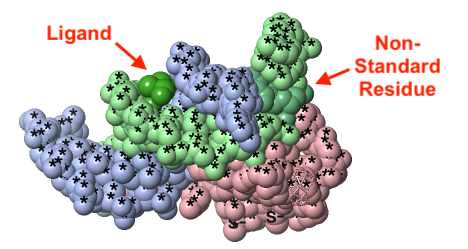
- Chain S consists of Ala166 + 3 non-standard residues numbered 167, 169, 170.
The amine of Ala166 is peptide-bonded
to muramic acid (MUB) which is glycosylated with NAG. The MUB-NAG dimer
is assigned unique chain ID A.
Water bound to MUB or NAG is assigned chain ID S even
though that water is bound to residues having chain ID A, and that water is
distant from residues of chain S.
|






 Clicking on an atom produces an identification
report in the Jmol rectangle, to the lower left of the molecule (see
snapshot at right), and also in the browser's status bar.
Amino acids are reported as
Clicking on an atom produces an identification
report in the Jmol rectangle, to the lower left of the molecule (see
snapshot at right), and also in the browser's status bar.
Amino acids are reported as
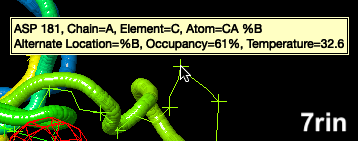
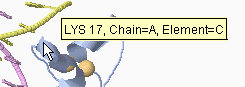 In addition to clicking, you can simply touch an atom with the mouse
(without moving the mouse, which is called "hovering"), and after a
delay of about two seconds, a yellow message will appear near the
mouse pointer (see snapshot at right) with an atom identification
report. This works best with Spin off.
In addition to clicking, you can simply touch an atom with the mouse
(without moving the mouse, which is called "hovering"), and after a
delay of about two seconds, a yellow message will appear near the
mouse pointer (see snapshot at right) with an atom identification
report. This works best with Spin off.
 These labels or marks are shown by default, but can be hidden by
unchecking the checkbox Labels: Show in the Focus Box at the bottom of any
of the upper left panels. (You may have to scroll the upper left panel
down to see this checkbox.)
These labels or marks are shown by default, but can be hidden by
unchecking the checkbox Labels: Show in the Focus Box at the bottom of any
of the upper left panels. (You may have to scroll the upper left panel
down to see this checkbox.)


















 Using Mouse Clicks:

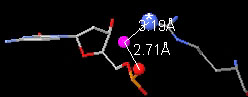 Water bridge in 1D66 between the sidechain
nitrogen of Arg 46
(chain B)
and a phosphate
oxygen of Arg 46
in Cytosine 13 (chain D).
Water bridge in 1D66 between the sidechain
nitrogen of Arg 46
(chain B)
and a phosphate
oxygen of Arg 46
in Cytosine 13 (chain D).
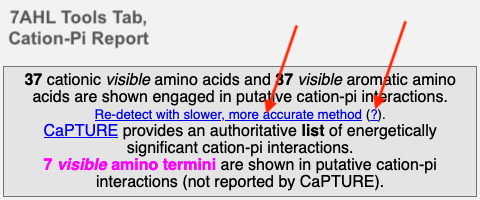 When the model is large, in order to save time, FirstGlance uses a faster but somewhat
less accurate method of detection than is used for the smaller 90% of entries in the
PDB. The faster method is used for models with >12,000 non-hydrogen
atoms, which are the largest ~10% of entries in the PDB. In these cases,
the slower method is offered if you wish greater accuracy. An example is
When the model is large, in order to save time, FirstGlance uses a faster but somewhat
less accurate method of detection than is used for the smaller 90% of entries in the
PDB. The faster method is used for models with >12,000 non-hydrogen
atoms, which are the largest ~10% of entries in the PDB. In these cases,
the slower method is offered if you wish greater accuracy. An example is
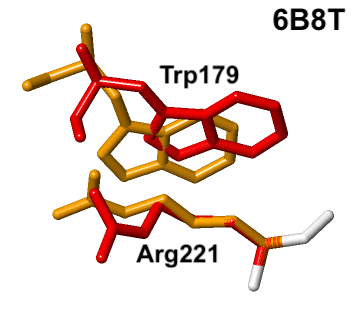
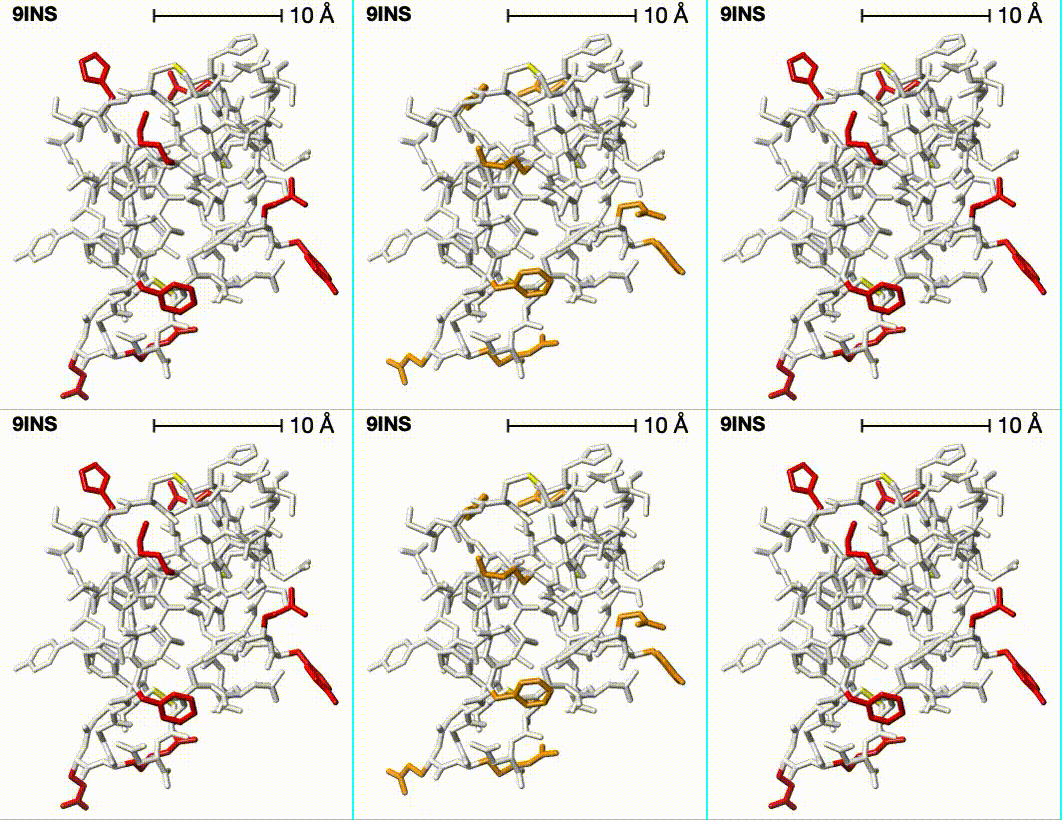


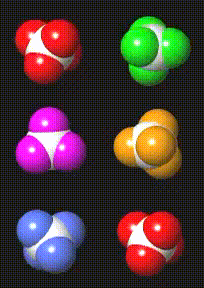
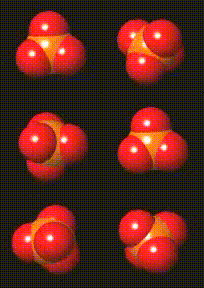
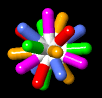
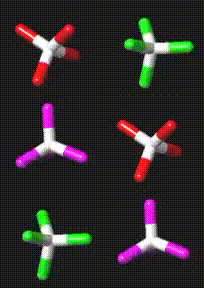
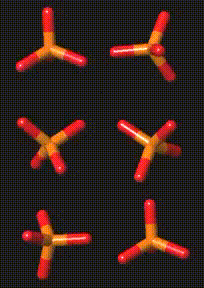
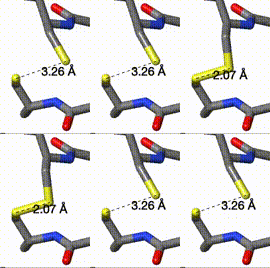
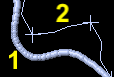 In FirstGlance,
the Cartoon,
In FirstGlance,
the Cartoon,
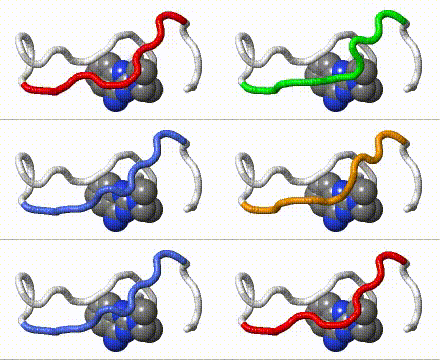
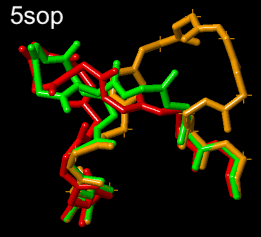
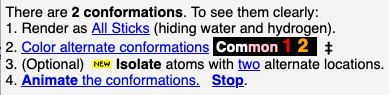 When the model has backbone forks, any view in the Views tab can be animated.
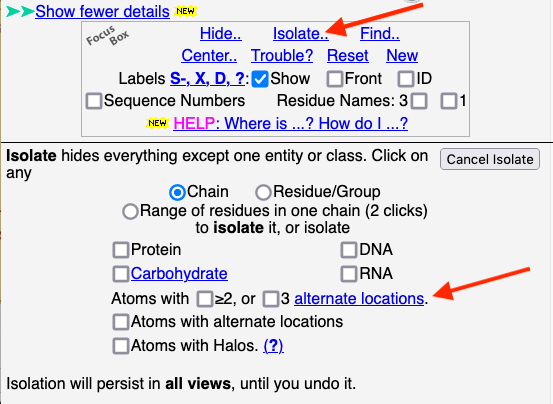
After clicking on alternate locations in the
When the model has backbone forks, any view in the Views tab can be animated.
After clicking on alternate locations in the
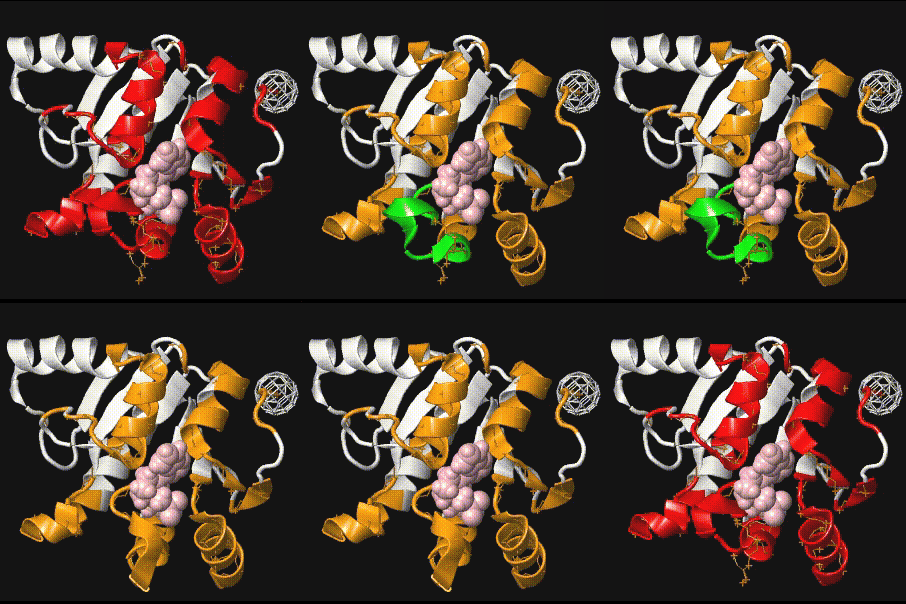

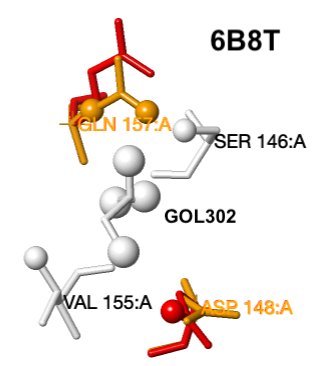
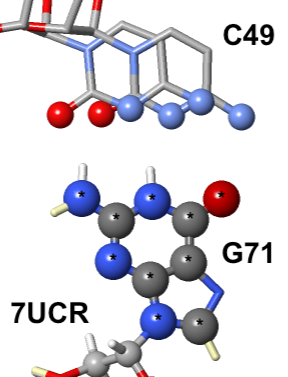
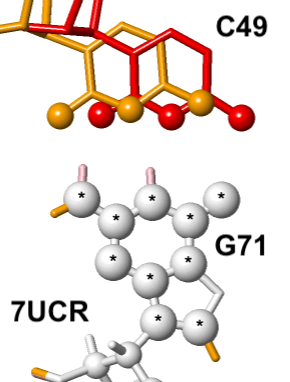
 appears below the molecule when any of the Unusual components or features
listed below are present.
appears below the molecule when any of the Unusual components or features
listed below are present.
 Problem. FirstGlance will often fail to display
anomalous atoms appropriately. Some anomalous atoms could be invisible
in all views except Vines (with details on).
Problem. FirstGlance will often fail to display
anomalous atoms appropriately. Some anomalous atoms could be invisible
in all views except Vines (with details on).